
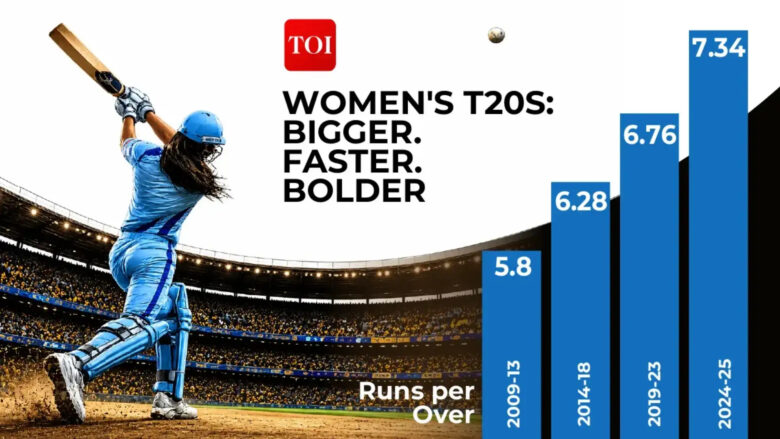
Women’s T20 cricket has shifted sharply towards faster scoring, with elite nations moving from 5.8 runs an over during 2009-13 to 7.34 in 2024-25, according to a Times of India analysis published before another Women’s T20 World Cup cycle.
Related cricket updates: Cricket Namibia Makes History: Women's Team Gets First Central Contracts!, Amanjot Kaur Injury: India Women's T20 Squad Updates and Amy Hunter: ICC's Top Women's Player of January 2024!.
IPL 2026 data links: IPL 2026 data hub, IPL 2026 points table, IPL 2026 Orange Cap, IPL 2026 Purple Cap, Vaibhav Sooryavanshi, Shubman Gill, Tilak Varma, Naman Dhir.
The analysis says run rates among the established top 10 women’s cricket nations rose by 27 percent across nearly two decades. The same data set says scoring reached 7.85 runs an over in 2025, the highest figure on record cited in the source article.
The change has altered the meaning of a par score in the format. The source article says 120 or 130 once looked competitive in women’s T20 cricket, while 150 now sits closer to a competitive benchmark rather than a commanding total.
Elite women’s T20 teams are scoring faster because boundary hitting and powerplay intent have increased
Elite women’s T20 sides have increased run rates while reducing dot balls, and the source article says boundary percentage among leading teams has risen by almost two-thirds over the years.
Women’s T20 batting previously followed a more cautious pattern, with batters often settling before attacking. The source article points to earlier eras involving Charlotte Edwards, Suzie Bates and Meg Lanning, when accumulation and wicket preservation were major parts of top-order batting.
Charlotte Edwards finished with more than 2600 T20I runs at a strike rate a little above 100, while Suzie Bates spent much of her career in similar strike-rate territory, according to the source article. Meg Lanning is described as a bridge between eras, combining consistency with greater aggression through an average above 36 and a strike rate close to 124.
The newer phase has pushed tempo higher. Beth Mooney is cited with an average close to 40 and a strike rate above 125, Nat Sciver-Brunt is cited with a strike rate above 120 and strong consistency, Hayley Matthews is described as one of the most dangerous powerplay batters, and Shafali Verma’s career strike rate is cited around 130.

Supplemental editorial cricket visual for Women's T20 scoring surge makes 150 the new benchmark.
Franchise leagues have helped turn high-scoring women’s T20 cricket into a habit
Franchise leagues are identified by the source article as a major driver of the faster batting mindset, with the Women’s Big Bash League laying the base before the Women’s T20 Blast, the WCPL and the Women’s Premier League added further exposure to attacking T20 cricket.
The analysis says the sharpest increase in international scoring aligns closely with the WBBL maturing and the WPL arriving. The source article frames that change as a habit shift: batters exposed to higher-tempo leagues began treating the first six overs as a scoring opportunity rather than only a phase to survive.
Shafali Verma, Hayley Matthews, Danni Wyatt-Hodge and Phoebe Litchfield are named in the source article as examples of players who attack early. The article also says powerplay scoring has improved faster than death-over scoring across the broader women’s T20 trend.
World Cup totals show how the 150 mark has changed in women’s T20 cricket
The Women’s T20 World Cup has reflected the wider scoring rise, with the source article stating that only one team crossed 150 in the 2012 tournament, while eight totals went past 150 in 2020.

Supplemental editorial cricket visual for Women's T20 scoring surge makes 150 the new benchmark.
The 2023 tournament in South Africa recorded 13 scores of 150 or more, according to the source article. Sri Lanka’s 213 against Scotland is cited as the highest total in Women’s T20 World Cup history.
The 2024 UAE edition brought those 150-plus numbers down, but the source article attributes that dip more to conditions than to a change in direction. Outside the World Cup, women’s T20I scoring rates continued to rise and reached the cited record level in 2025.
England, India and Australia show different routes to the same scoring shift
England recorded the largest acceleration between early Women’s T20 World Cups and recent editions in the source comparison, while India made the biggest powerplay jump among the named teams.
| Team | Early World Cups comparison | Recent World Cups comparison | Key change cited |
|---|---|---|---|
| England | Run rate of 6.41 and powerplay rate of 6.5 | Run rate of 7.82 and powerplay rate of 7.85 | England accelerated hardest in the comparison |
| Australia | Run rate of 6.76 | Run rate of 7.48 | Australia lifted scoring while remaining the dominant side cited by the source |
| India | Powerplay rate of 4.74 | Powerplay rate of 7.20 | India made the biggest powerplay leap cited in the analysis |
| South Africa | Lower earlier scoring base cited | Sharp rise cited | South Africa climbed sharply in the comparison |
| New Zealand | Earlier World Cup scoring level cited | Slightly lower recent scoring level cited | New Zealand was the only top side cited as not joining the surge |
The India figure is tied in the source article to a top-order rebuild around aggression. The source article does not give a named selection change, squad list or injury update connected to that trend.
Richa Ghosh leads the strike-rate group among recent high-volume batters
Richa Ghosh leads the cited group of women’s T20I batters with 500-plus runs since 2023, with the source article placing the India wicketkeeper-batter’s strike rate near 150.
Richa Ghosh is described as a designated finisher and as a holder of the joint-fastest fifty in women’s T20I history. The source article lists Pakistan’s Fatima Sana, England’s Danni Wyatt, Australia’s Phoebe Litchfield and India’s Shafali Verma behind Richa Ghosh in the same recent strike-rate group.
The wider takeaway is clear from the source data: women’s T20 batting has moved from cautious accumulation towards earlier aggression, stronger boundary frequency and higher expectations for first-innings totals.