
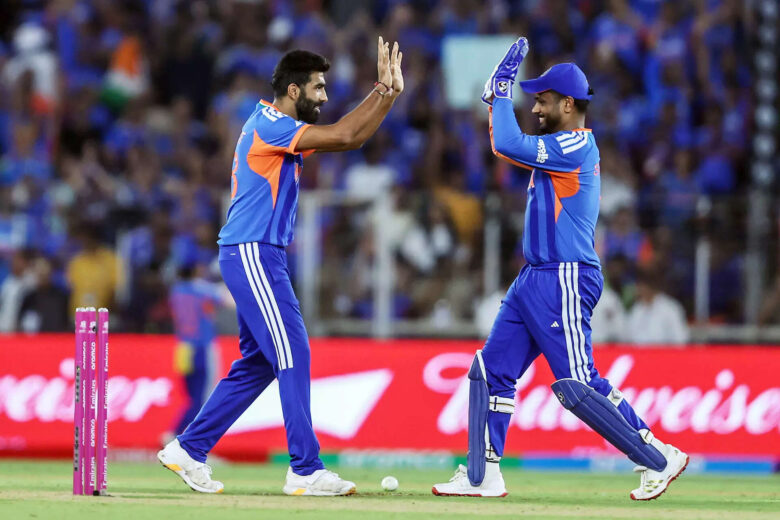
Team India Report Card: Player Ratings from the Historic Third T20 World Cup Triumph
Team India has secured a historic third T20 World Cup title, becoming the first men’s side to successfully defend the championship. Competing primarily on home soil, Suryakumar Yadav’s squad delivered a highly effective campaign defined by aggressive top-order batting and disciplined death bowling. This victory marks a significant milestone for the Board of Control for Cricket in India.
Below is the definitive performance report card and statistical breakdown for the 15-man squad and coaching staff, featuring performance metrics verified against official International Cricket Council data.
Team Leadership & Coaching
Gautam Gambhir (Head Coach)
Rating: 9/10
Gambhir became the first individual to win a T20 World Cup as both a player and a coach. He engineered the team’s offensive strategy, instructing batters to ignore personal milestones in favor of maximizing strike rates. The coaching staff demonstrated strategic patience by backing players like Abhishek Sharma and Varun Chakravarthy through early-tournament performance slumps.
Suryakumar Yadav (Captain)
Rating: 7.5/10
Yadav managed the bowling rotations and batting order adjustments effectively under pressure. While his leadership proved decisive, his individual batting output dropped below his standard averages. He recorded a single half-century—an unbeaten 84 off 49 balls against the USA—which stabilized the innings after an early top-order collapse.
| Matches | Runs | Strike Rate | Average | 50s |
|---|---|---|---|---|
| 9 | 242 | 136.72 | 30.25 | 1 |
Top-Order Batters
Sanju Samson
Rating: 10/10
Samson dismantled opposition bowling attacks consistently, functioning as the primary run-scorer in the knockout stages. He recorded an unbeaten 97 against the West Indies, followed by consecutive 89-run innings against England in the semifinal and in the final. This output made him only the second batter to register three consecutive 80-plus scores at a T20 World Cup. His final innings of 89 established a new record for the highest individual score in a men’s tournament final, earning him Player of the Tournament honors.
| Matches | Runs | Strike Rate | Average | 50s |
|---|---|---|---|---|
| 5 | 321 | 199.37 | 80.25 | 3 |
Ishan Kishan
Rating: 9/10
Kishan provided aggressive starts at the top of the order, finishing as the tournament’s fourth-highest run-scorer. His standout performance occurred against Pakistan, where he scored 77 runs off 40 deliveries. He also delivered a high-impact innings in the final, contributing a rapid 54 off 25 balls.
| Matches | Runs | Strike Rate | Average | 50s |
|---|---|---|---|---|
| 9 | 317 | 193.29 | 35.22 | 3 |
Tilak Varma
Rating: 7.5/10
After an initial struggle at the No. 3 position, Varma successfully transitioned to the middle order. He contributed an unbeaten 44 off 16 balls against Zimbabwe, 27 off 15 against the West Indies, and 21 off 7 deliveries in the semifinal against England—an innings highlighted by three consecutive sixes off Jofra Archer.
| Innings | Runs | Strike Rate | Average | 50s |
|---|---|---|---|---|
| 9 | 207 | 154.47 | 29.57 | 0 |
Abhishek Sharma
Rating: 6/10
Sharma faced severe early-tournament struggles, registering three ducks in his first three innings while repeatedly falling to opposition off-spinners. Despite media speculation regarding his removal from the final lineup, he retained his position and responded by scoring the fastest half-century of the tournament off just 18 deliveries.
| Matches | Runs | Strike Rate | Average | 50s |
|---|---|---|---|---|
| 8 | 141 | 158.42 | 17.62 | 2 |
All-Rounders
Hardik Pandya
Rating: 8.5/10
Pandya operated as a highly reliable all-rounder during high-leverage situations. He recorded half-centuries against Namibia and Zimbabwe, and scored 27 off 12 balls in the semifinal against England to push India past 250 runs. As a bowler, he secured figures of 2/16 against Pakistan and effectively ended England’s semifinal chase by conceding just nine runs and taking two wickets in the 19th over.
| Matches | Runs | Batting SR | Wickets | Economy |
|---|---|---|---|---|
| 9 | 217 | 160.74 | 9 | 8.81 |
Shivam Dube
Rating: 8/10
Dube anchored the middle order during early collapses and provided late-innings acceleration. He scored a 31-ball 65 against the Netherlands to recover the innings to 193. During the final, he dominated the 20th over by scoring 24 runs, elevating the team total to 255. He also neutralized England’s spin attack in the semifinal with a 25-ball 43.
| Matches | Runs | Batting SR | Wickets | Economy |
|---|---|---|---|---|
| 9 | 235 | 169.06 | 5 | 14.12 |
Axar Patel
Rating: 8/10
While rarely required to bat, Patel excelled as a primary spin option, securing 11 dismissals across the tournament. He delivered a high-impact performance in the final with figures of 3/27. Additionally, he executed two game-altering catches in the outfield during the semifinal.
| Matches | Runs | Strike Rate | Wickets | Best Bowling |
|---|---|---|---|---|
| 7 | 16 | 106.66 | 11 | 3/27 |
Washington Sundar
Rating: 5/10
Utilized primarily for roster depth, Sundar appeared in two matches. He recorded bowling figures of 0/36 against the Netherlands and 0/17 against South Africa, managing 11 runs in his sole batting appearance against the Proteas.
| Matches | Runs | Batting SR | Wickets | Economy |
|---|---|---|---|---|
| 2 | 11 | 100.00 | 0 | 8.83 |
Pace & Spin Bowling Attack
Jasprit Bumrah
Rating: 10/10
Suryakumar Yadav accurately categorized Bumrah as a “national treasure.” Operating on flat pitches where opposing bowlers conceded heavy run totals, Bumrah maintained an elite economy rate of 6.21. He finished as the joint-top wicket-taker with 14 dismissals. In the semifinal, he restricted England to just 14 runs across two death overs when they required 69 off 30 balls. He secured Player of the Match honors in the final after registering figures of 4/15.
| Matches | Wickets | Economy | Average | Strike Rate |
|---|---|---|---|---|
| 8 | 14 | 6.21 | 12.42 | 12.00 |
Arshdeep Singh
Rating: 7.5/10
Operating on primarily high-scoring surfaces, Singh provided consistent wicket-taking ability. He delivered strong bowling performances in the Super Eight match against Zimbabwe and the semifinal against England, maintaining the team’s trust throughout the campaign.
| Matches | Wickets | Economy | Average | Strike Rate |
|---|---|---|---|---|
| 8 | 9 | 8.46 | 28.22 | 20.00 |
Varun Chakravarthy
Rating: 7/10
Chakravarthy experienced a highly polarized tournament. During the group stage, he operated with excellent economy and secured nine wickets. However, across his final five matches, his economy rate climbed to 11.84, yielding only five additional wickets. Despite the late-tournament regression, finishing with 14 wickets represents a strong statistical baseline.
| Matches | Wickets | Economy | Average | Strike Rate |
|---|---|---|---|---|
| 9 | 14 | 9.25 | 20.50 | 13.20 |
Mohammed Siraj
Rating: 7/10
Added to the roster as a late replacement for Harshit Rana, Siraj featured only in the opening match against the USA. Stepping in for an ill Jasprit Bumrah, he secured figures of 3/29.
| Matches | Wickets | Economy | Average | Best Bowling |
|---|---|---|---|---|
| 1 | 3 | 7.25 | 9.66 | 3/29 |
Kuldeep Yadav
Rating: 7/10
Yadav participated in a single fixture, playing against Pakistan in Colombo. He delivered an accurate three-over spell, recording figures of 1/14 before rotating out of the active playing XI for the remainder of the tournament.
| Matches | Wickets | Economy | Average | Best Bowling |
|---|---|---|---|---|
| 1 | 1 | 4.66 | 14.00 | 1/14 |
Depth & Substitutes
Rinku Singh
Rating: 5/10
Singh faced a challenging tournament both professionally and personally, having lost his father midway through the event. Relegated to brief cameo roles that limited his scoring opportunities, he eventually rotated out of the starting XI. However, he remained highly active as a substitute fielder, consistently appearing in defensive highlight reels.
| Matches | Runs | Strike Rate | Average | 50s |
|---|---|---|---|---|
| 5 | 24 | 82.75 | 8.00 | 0 |
Tournament Conclusion
This historic title defense cements Team India’s dominance in the shortest format. The integration of high-strike-rate batting philosophies and elite death bowling provides a definitive blueprint for future global tournaments. For complete historical records and match logs, researchers can reference the ESPN Cricinfo database.