
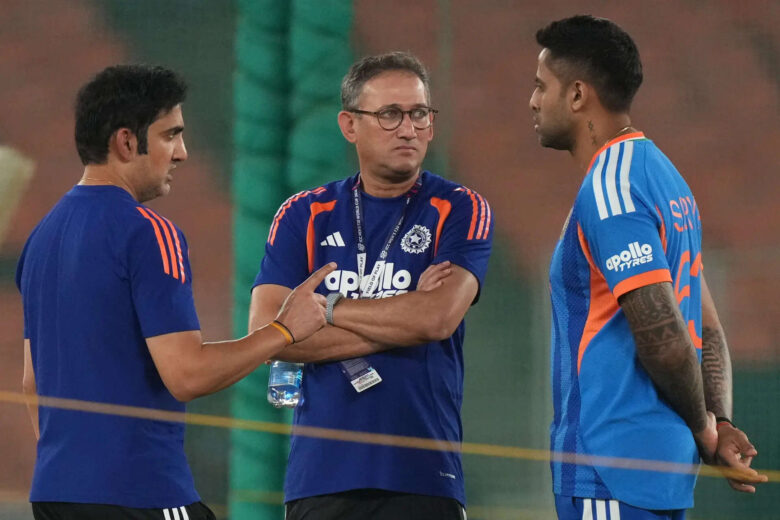
Gambhir and Agarkar’s Next Challenge: Navigating India’s Cricket Roadmap Post-T20 World Cup
Following India’s historic 2024 T20 World Cup victory under Rohit Sharma in Barbados, newly appointed T20I captain Suryakumar Yadav has set his sights on the next major frontier: an Olympic gold medal at the Los Angeles 2028 Games. The ambition is clear, but executing this long-term vision requires a highly calculated approach from the team management.
The Post-Barbados Transition
Head coach Gautam Gambhir and chief selector Ajit Agarkar have made it clear that maintaining India’s status as a global cricket superpower demands ruthless decision-making. The transition period following the Caribbean triumph has seen a distinct shift away from individual milestones toward a rigid, results-driven philosophy.
- Leadership Realignment: Due to recurring injury concerns, designated vice-captain Hardik Pandya was bypassed for the primary leadership role, allowing Suryakumar Yadav to assume the T20I captaincy.
- Spin Department Adjustments: Kuldeep Yadav, the lead spinner during the 2024 campaign, has seen stiff competition from Varun Chakravarthy as the management tests different variations for bilateral series.
- Top-Order Rotations: Players like Yashasvi Jaiswal and Shubman Gill have experienced fluctuations in the pecking order based on format-specific requirements and expected match conditions.
Managing Dressing Room Dynamics
Gambhir has consistently prioritized a team-first ethos, actively working to neutralize any superstar culture that could disrupt squad harmony. Former India selector Devang Gandhi emphasized the distinction between natural stardom and undue entitlement.
“Indian cricket will always throw up superstars,” Gandhi stated. “Every sport will have superstars. People need to understand if the player is exercising undue entitlements like traveling alone and staying separately from the rest of the team. Because all that affects the dressing room culture. Big players will go through an odd slump. It is all about what the player brings to the team.”
Strategic Focus: Stabilizing the ODI Core
While the Los Angeles 2028 Olympics and the 2026 T20 World Cup are major targets, the immediate priority for Gambhir and Agarkar is stabilizing the One-Day International (ODI) squad ahead of the 2027 ODI World Cup in South Africa, Zimbabwe, and Namibia. The 50-over format requires a different physiological and tactical approach compared to the rapid pace of T20 cricket.
Upcoming Global Milestones for Team India
| Year | Tournament | Format | Primary Locations |
|---|---|---|---|
| 2026 | T20 World Cup | T20I | India, Sri Lanka |
| 2027 | ODI World Cup | ODI | South Africa, Zimbabwe, Namibia |
| 2028 | Olympic Games | T20 | Los Angeles, USA |
Former India wicketkeeper Deep Dasgupta highlighted the importance of preparing for Southern Hemisphere conditions. “I do not see there is any need to bring about immediate changes. This set of boys are more T20 specialists and are extremely high on confidence. The focus will be on the ODI team. Just as they prepared for the recent World Cup, surely they will judge the players’ ability in SENA countries since the next cycle of BCCI and ICC events will happen in South Africa, Australia, and New Zealand.”
The Path Forward
Gambhir has publicly advocated for tactical flexibility, which directly contrasts with the predictable continuity many teams rely on. Managing fluctuating player form—such as ensuring Chakravarthy’s mystery spin remains effective against international scouting—will test the management’s resolve.
Gambhir and Agarkar have endured sustained criticism for their aggressive roster management over the past 18 months. As India prepares for an unprecedented density of major tournaments between 2026 and 2028, their willingness to make unpopular, data-backed decisions will remain the primary driver of India’s future success.