
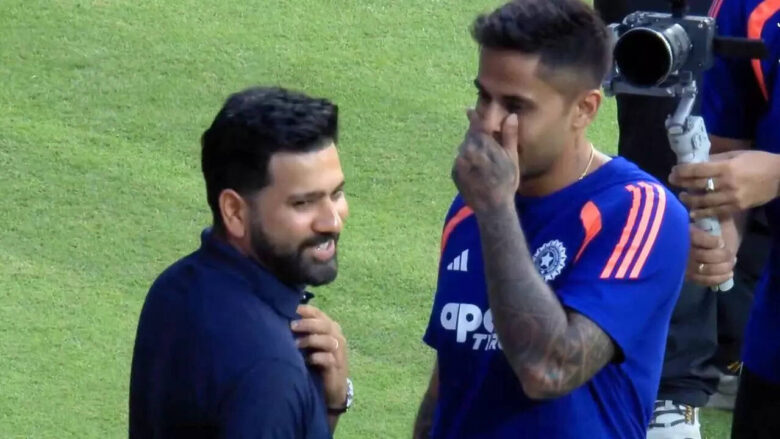
Following the Blueprint: How Suryakumar Yadav is Channeling Rohit Sharma’s Captaincy for India’s T20 Future
When Suryakumar Yadav inherited the Indian T20 International (T20I) captaincy following the team’s undefeated run to the 2024 ICC T20 World Cup title, the comparisons to his predecessor were immediate. Addressing the expectations of replacing a World Cup-winning captain, Yadav offered a pragmatic assessment: “Joota mera hi hai, footsteps unke hain” (The shoes are mine, I only follow his footsteps). As India builds toward the 2026 T20 World Cup, Yadav is actively deploying the aggressive blueprint established by Rohit Sharma.
The Rohit Sharma Blueprint in Modern T20Is
Sharma’s strategic shift began after India’s 10-wicket defeat to England in the 2022 T20 World Cup semifinal in Adelaide. Recognizing the need for a modern, high-strike-rate approach, Sharma fundamentally altered India’s white-ball DNA. This transition culminated in lifting the trophy in Bridgetown, Barbados, ending an 11-year ICC title drought for the Board of Control for Cricket in India (BCCI).
Yadav, who developed into the top-ranked T20I batter under Sharma’s leadership at both the national level and with the Mumbai Indians, acknowledges the structural advantages of this system.
- Aggressive Powerplay Batting: Maximizing the first six overs regardless of early wickets to pressure opposition bowlers.
- Role Clarity: Assigning specific middle-order responsibilities rather than relying on traditional, slow-building anchors.
- Data-Driven Matchups: Utilizing bowler-batter statistics to dictate bowling changes and field placements.
Player Management and the Sanju Samson Paradigm
Effective leadership extends beyond tactical field placements. Sharma’s man-management during the 2024 campaign set a high standard for Yadav to emulate. A prime example is Sanju Samson. Despite missing the starting XI in the final against South Africa, Samson highlighted Sharma’s transparent communication.
“He spent 10 minutes with the player who was not playing just before the toss,” Samson revealed during a recent interview. “At that point, he thought, ‘I have to explain to Sanju why I took that decision.’ At that moment, he won a place in my heart.”
Yadav now faces similar selection dilemmas, balancing left-handed top-order options like Abhishek Sharma, Ishan Kishan, and Tilak Varma, while integrating aggressive shot-makers like Samson who provide middle-order stability.
Captaincy Records: Transitioning Eras
The statistical foundation Sharma left provides Yadav with a high-performing core. Nine of the 15 players currently in the rotation were part of the Caribbean championship squad.
| Indian Captain | T20I Matches | Wins | Losses | Win Percentage | ICC Titles |
|---|---|---|---|---|---|
| Rohit Sharma | 68 | 49 | 18 | 72.05% | 1 (2024 T20 WC) |
| MS Dhoni | 72 | 41 | 28 | 56.94% | 1 (2007 T20 WC) |
Data sourced from ESPN Cricinfo records.
The Crossroads Ahead
While Yadav establishes his leadership identity, the ultimate lesson he can extract from Sharma involves succession planning. Following the 2024 victory, Sharma retired from T20Is while still performing at an elite level, clearing the path for the next generation.
As Yadav leads the International Cricket Council (ICC) rankings and the national team toward the 2026 tournament co-hosted by India and Sri Lanka, his mandate is well-defined: sustain the aggressive paradigm, secure the silverware, and recognize the exact moment to hand the baton to the next wave of Indian talent.